Social Learning Platform Analysis – YouTube
Platform Choice & Justification
For my Social Learning Platform Analysis, I chose YouTube because I use it for a lot of different things including learning university concepts, cybersecurity and programming, and entertainment like sports, cars, lifestyle, politics, news, and sometimes livestreams.
For university, YouTube is very useful when I am taking a hard course and there are no recorded lectures, I missed a class, or I just did not understand a topic. There are usually many videos explaining the same topic in different ways. I am a visual learner so I understand topics better through visual explanations and by working through examples, so I can watch a video that explains the concept and another video that has questions and answers so I understand the topic fully. Moreover, YouTube videos don’t feel like lectures because they don’t follow a one dimensional style of teaching. When searching for a topic, users can find different creators with different styles of teaching and a user can pick which style works for them. For example, searching for matrix algebra gives users many different videos and creators to choose from.
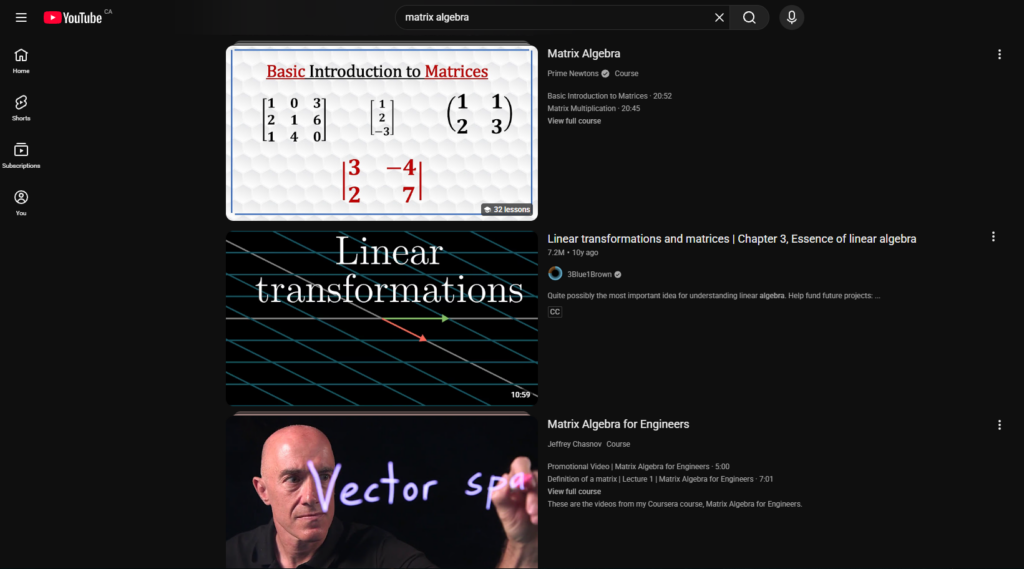
I think that YouTube is a great example of a social learning platform because the creators feel more like a peer explaining a concept rather than an instructor explaining to a class. This is because communities are a big part of a channel, creators interact with their communities by replying to their comments, suggestions, or even using their ideas or questions for future videos.
I remember a couple of months ago I was following a video tutorial of an older programming project, and I had some errors which the video didn’t show. So I went to the comments and the first comment I saw was someone saying he had the same errors and after doing some research, he found out that the library the video used was outdated and not working. He then offered a new library that was working, and his comments had many likes and even the creator liked it. Without that comment and that community, I would have just assumed that I was doing something wrong.
Platform Analysis:
For the Analytical Framework, I will be evaluating YouTube using these four criteria: discoverability and algorithms, community and participation, credibility, and accessibility and inclusion. These criteria connect to course concepts like affordances, cognitive offloading, PLNs, information disorder, epistemic bubbles, and diversity and inclusion.
Discoverability and Algorithms
One of YouTube’s biggest strengths is that when users search for a specific topic, there is a good chance that they will find it in the first few videos. A couple of years ago, YouTube added timestamps and chapters to videos, which also made it very easy and convenient for viewers so they don’t have to watch the whole video when they are looking for something specific. The screenshot below shows how chapters allow users to quickly find a specific part of a video.
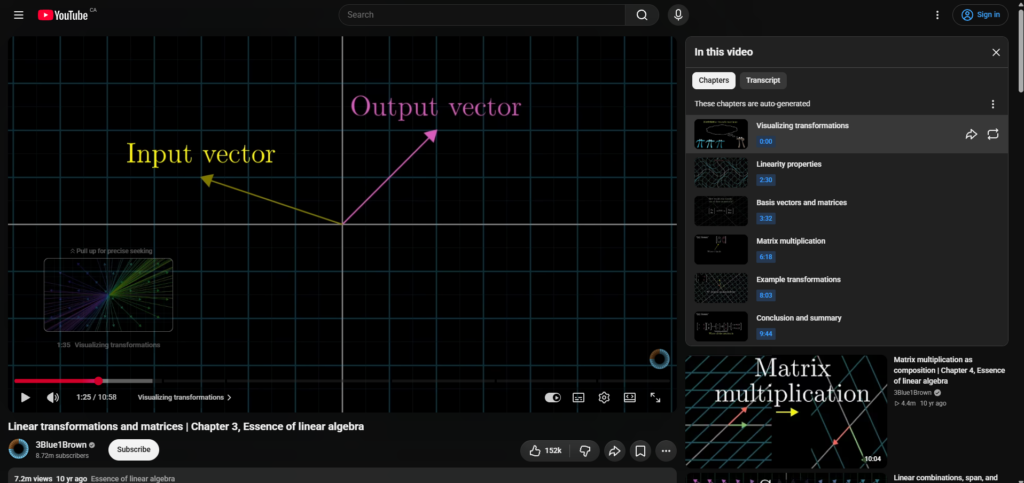
Recommendations can also help with learning. For example, if I watch an introduction to linear algebra, YouTube might recommend something like matrix multiplication next without me having to search for it myself. This connects to Risko and Gilbert’s (2016) idea of cognitive offloading because part of deciding what to learn next is being done by the platform.
On the other hand, recommendations can also limit users because after watching a few videos about a topic, their homepage can be filled with the same type of content even after they are finished with it. This can connect to Nguyen’s (2020) idea of epistemic bubbles, where certain information becomes more visible while other perspectives or topics are left out.
Community and Participation
The comment section is another one of YouTube’s biggest strengths and a major part of what makes YouTube a social learning platform. I don’t comment often, but when I do, it’s usually because I have a question, want to reply to someone, or I really like a video and want to give a compliment. Having an active community where viewers can answer questions, share experiences, correct mistakes, and recommend resources can connect to PLN because learning does not only happen between the creator and the viewer. The screenshot below shows an example of viewers using the comment section to add useful information to a video. Some users were complimenting the creator, some were giving recommendations, and others were giving feedback, like one user said that sometimes the music was louder than his voice.
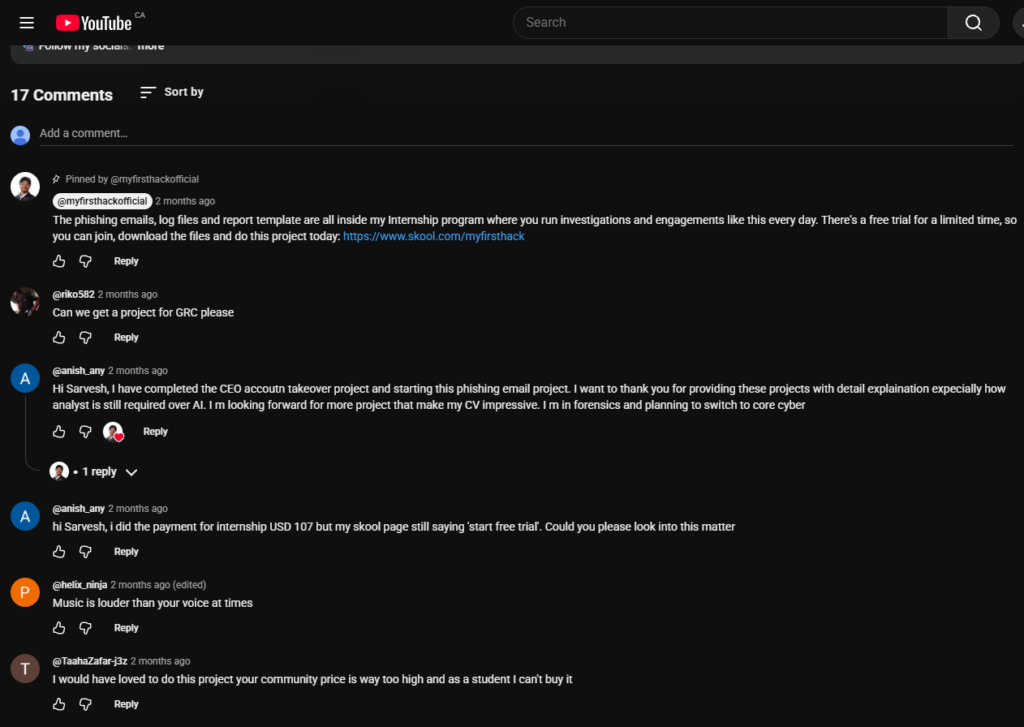
While some comment sections can have useful discussions and helpful people, others are filled with jokes, arguments, trolls, and spam.
Credibility
Credibility is probably one of YouTube’s biggest weaknesses because when I am deciding which video to watch and if it’s trustworthy, I usually look at the video’s views, likes, and comments. But these things are not always a good reflection, a high view count can tell a user that the video is reliable, but it can give a false sense of credibility. Clickbait is a good example because a thumbnail or title may fool the user into believing that the video has exactly what they need, but that is not the case. This can happen because creators have a financial incentive to prioritize clicks and views over quality.
Another design choice that affected this was YouTube removing the public dislike count. I think dislikes were useful because they gave users another way to see how the community felt about a video. It did not automatically mean the video was wrong, but it gave the learner another signal to consider. The screenshot below shows how the dislike button is still available, but the number of dislikes is hidden from viewers.
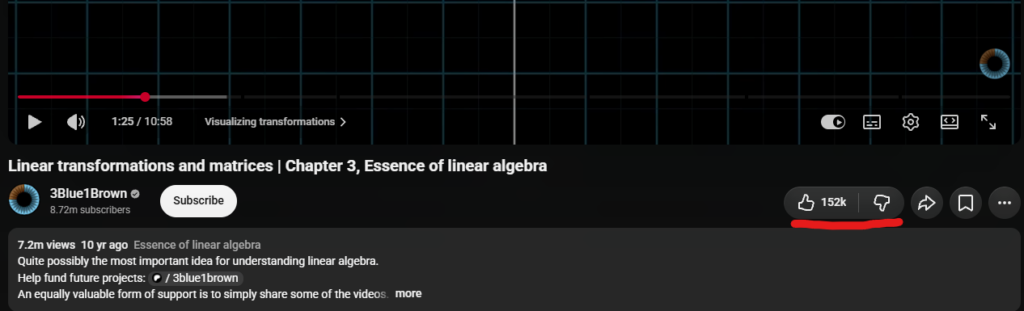
This connects to information disorder from Wardle and Derakhshan (2017). When using YouTube, I still need to think about who made the video, why they made it, and what they are trying to convince me of.
For me personally, I don’t fully trust videos on YouTube about important topics like medical information, finance, and politics. I would actually need to research these topics and look into external sources and research because creators may not be experts and they may have sponsorships or financial incentives.
Accessibility and Inclusion
As a visual learner, YouTube gives me options that I do not always get through traditional learning. I regularly use playback speed, captions, timestamps, pause, rewind, and sometimes transcripts. If I do not understand something, I can stop the video and go back, or find another creator who explains it differently. The screenshot below shows some of the features YouTube gives users to control how they learn from a video.
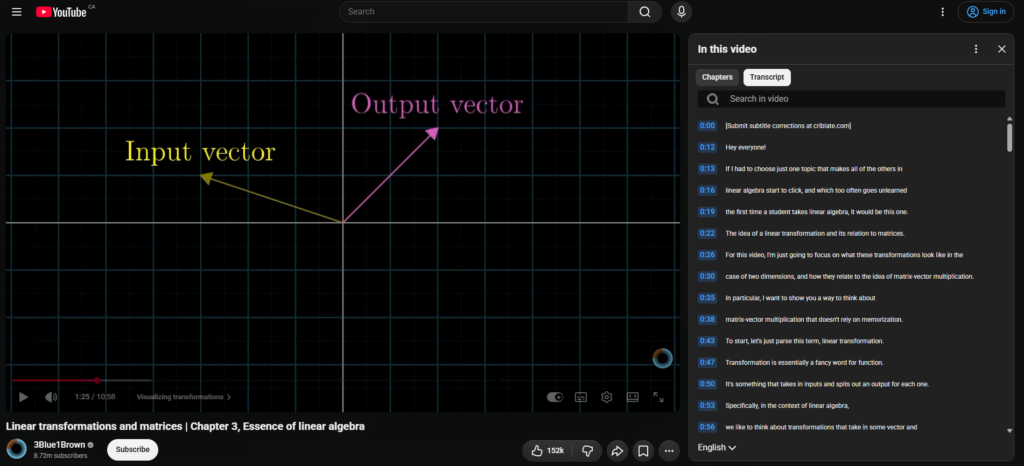
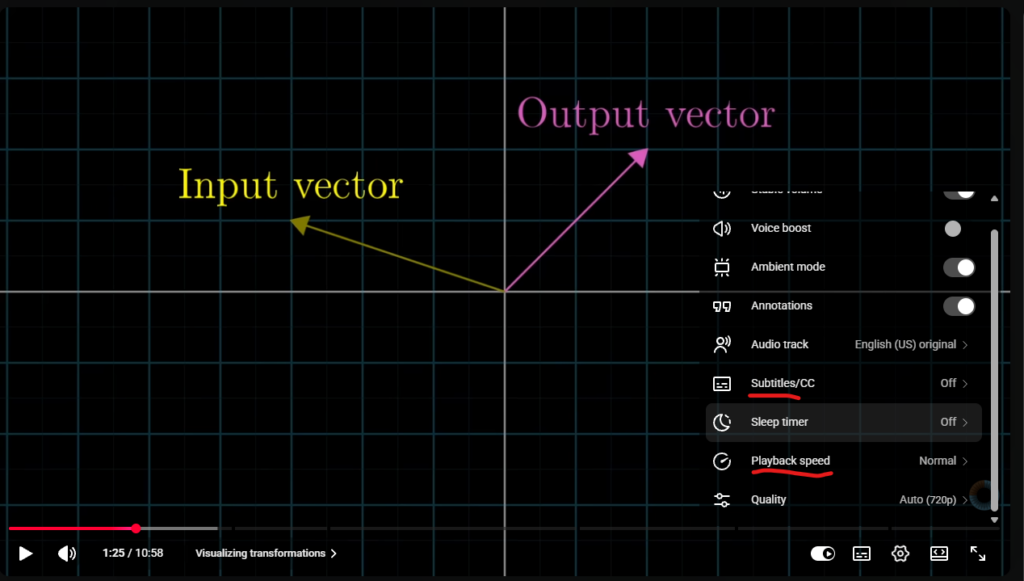
Someone with a hearing impairment could struggle with YouTube’s automatic captions, which are not perfect and can be inaccurate, especially with technical terms, scientific language, coding syntax, or accents. Another point is that someone without stable internet may struggle to watch a video because of buffering or have to lower the video quality, which can negatively affect their experience. Because of the lower quality, the user might find it difficult to follow a video if the video contains small text, code, diagrams, or a whiteboard.
Reflection & Implications
After analyzing YouTube, I think its biggest strength is how much control it gives learners over how they learn. I can choose the creator, teaching style, video length, speed, and even switch between different explanations until I find one that works for me. The community can also add information that the original creator missed.
At the same time, I do not think the learner has complete control. YouTube’s recommendations influence what appears in front of us, popular creators can seem more trustworthy because of their subscribers and views, and financial incentives can encourage clickbait over quality.
The biggest thing I took away from this analysis is that YouTube makes learning extremely convenient, but convenience does not automatically make the information reliable. I think YouTube works best when the learner takes advantage of its flexibility while still questioning information, checking other sources when needed, and making an effort to look outside of what the algorithm automatically recommends.
References:
Bucher, T., & Helmond, A. (2018). The affordances of social media platforms. In J. Burgess, A. Marwick, & T. Poell (Eds.), The SAGE Handbook of Social Media (pp. 233–253). SAGE Publications.
Nguyen, C. T. (2020). Echo chambers and epistemic bubbles. Episteme, 17(2), 141–161.
Risko, E. F., & Gilbert, S. J. (2016). Cognitive offloading. Trends in Cognitive Sciences, 20(9), 676–688.
Wardle, C., & Derakhshan, H. (2017). Information disorder: Toward an interdisciplinary framework for research and policy making. Council of Europe
YouTube. (2021, November 10). An update to dislikes on YouTube. YouTube Blog.